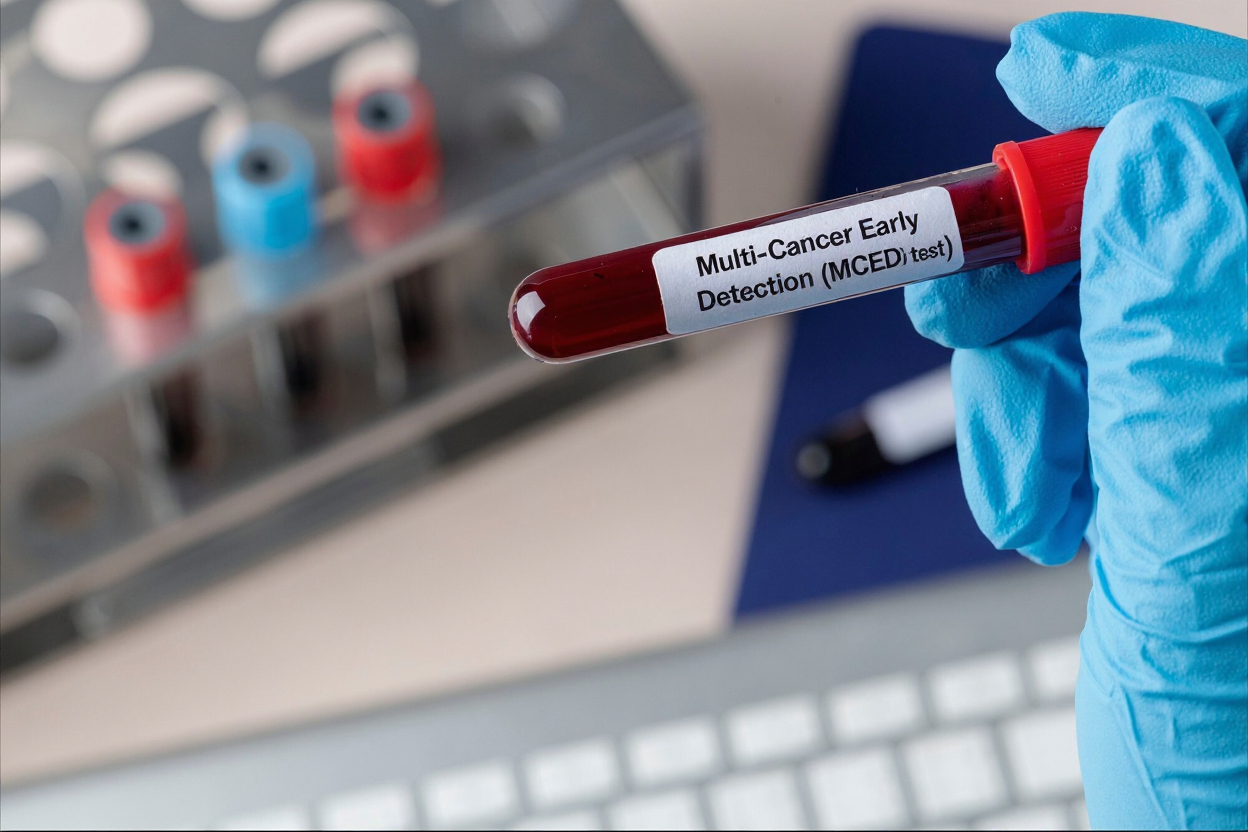
In research published this week, scientists reported that a new type of multi-cancer early detection (MCED) blood test — which examines patterns in circulating tumor cell-free DNA — demonstrated high sensitivity and specificity in identifying multiple cancers and predicting their tissue of origin.
The findings, drawn from one of the largest cohorts to date, mark a significant step forward for cancer diagnostics that aim to identify disease before symptoms appear, potentially improving outcomes through earlier treatment.
Large validation shows high accuracy
The study, published in Nature Medicine, evaluated a novel MCED test analyzing cfDNA from whole-genome sequencing and advanced fragmentomics — the study of DNA fragment patterns in the blood.
Overall results in the independent validation cohort were as follows:
-
87.4% sensitivity in detecting cancers overall
-
97.8% specificity (low rate of false positives)
-
82.4% accuracy in predicting the cancer’s likely tissue of origin
-
In preliminary prospective screening, early-stage cancers were detected at a sensitivity of 53.5% with 98.1% specificity.
These figures suggest that the test not only identifies cancer signals from a simple blood draw, but often provides directional guidance about where the tumor is located in the body.
Why this matters
Cancer survival improves dramatically with early detection. For many deadly cancers — such as pancreatic, ovarian, and liver cancers — there are currently no routine screening tests, and diagnosis often occurs only after symptoms emerge and the disease has progressed.
Traditional screening tools, such as mammograms (breast cancer) or colonoscopies (colorectal), are specific to a single organ, leaving the majority of cancer types without early detection capabilities.
Multi-cancer early detection tests aim to fill this gap by detecting signals from dozens of cancer types with a single, minimally invasive blood draw.
Supporting research: tumor DNA detectable years earlier
Earlier work from researchers at Johns Hopkins University showed that fragments of tumor-derived DNA can sometimes be detected in the bloodstream up to three years before clinical diagnosis.
In that study, investigators analyzed plasma samples from participants who were later diagnosed with cancer. In several cases, they were able to identify tumor DNA mutations in samples drawn more than three years before the official cancer diagnosis, suggesting a substantial diagnostic window that could enable earlier intervention.
“These results demonstrate that it is possible to detect circulating tumor DNA more than three years prior to clinical diagnosis,” the authors wrote, highlighting the potential of highly sensitive sequencing technologies for early cancer detection.
Broader implications for screening programs
In another recent modeling study, researchers examined how incorporating annual MCED testing into standard screening could affect cancer outcomes on a population level.
The analysis projected:
-
10% more early (stage I) diagnoses
-
20% more stage II diagnoses
-
30% more stage III diagnoses
-
45% fewer late (stage IV) diagnoses
compared with standard care without MCED testing.
Such shifts in stage distribution could lead to meaningfully improved survival rates for many cancer types, especially those without existing screening options.
Technological advances driving progress
Modern MCED tests go beyond simple mutation detection. They incorporate:
-
fragmentation patterns of cfDNA
-
methylation signatures
-
machine-learning models trained on large genomic datasets
to distinguish cancer from noncancer signals and estimate the tumor’s tissue of origin. These approaches expand the biological signals available for detection and improve performance across diverse cancer types.
AI and advanced computational techniques are now essential in analyzing complex genomic data and extracting clinically useful information from tiny amounts of circulating tumor DNA.
Limitations remain
While the recent study shows strong potential, several challenges remain before MCED tests can be widely used in routine clinical practice:
-
Lower sensitivity for very early (stage I) cancers: Even with promising results, early-stage sensitivity was lower than overall detection.
-
Need for follow-up diagnostics: A positive screening result still requires confirmatory imaging and biopsy to establish a diagnosis.
-
Cost and access: Most MCED tests are not yet approved for general screening and are currently expensive, limiting accessibility.
-
Clinical outcome data: Large, prospective trials linking early detection to reduced mortality are still needed.
Regulatory bodies and public health experts emphasize careful evaluation of benefits versus harms — including false positives and unnecessary procedures — before recommending widespread adoption.
What’s next
Researchers are continuing to refine MCED technologies to:
-
improve early-stage cancer detection
-
reduce false positives
-
validate performance across diverse populations
-
integrate results into health systems in a practical way
Ongoing and upcoming large clinical studies will be crucial in determining whether MCED tests ultimately deliver measurable reductions in cancer mortality, the key benchmark for screening interventions.
Source Journal
-
Early detection of multiple cancer types using multidimensional cell-free DNA fragmentomics — Nature Medicine (2025) DOI: 10.1038/s41591-025-03735-2