What if one of the most feared consequences of growing older — the slow, creeping loss of memory and mental sharpness — could actually be reversed?
That question has driven decades of research into the aging brain, and the answers have always come up short. But a team of scientists at Texas A&M University may have just changed the conversation entirely. Their new study, funded by the National Institute on Aging (NIA) and published in the Journal of Extracellular Vesicles, describes a nasal spray that — after just two doses — dramatically reduced brain inflammation, restored the brain’s cellular energy systems, and significantly improved memory in aged subjects.
Most remarkably, the results did not fade quickly. The improvements appeared within weeks and persisted for months.
The Hidden Fire Inside the Aging Brain
To understand why this discovery matters, you need to understand what scientists call “neuroinflammaging” — a term that blends “neuroinflammation” with “aging.”
As the brain grows older, something quietly goes wrong in its immune system. Microglia — the brain’s dedicated immune cells, responsible for sweeping away debris and protecting neurons — gradually shift from protectors into troublemakers. Instead of switching off after doing their job, they stay permanently activated, releasing a low-grade but continuous stream of inflammatory signals deep inside the brain’s memory center, the hippocampus.
This is not the dramatic, acute inflammation you might feel from an infection or injury. Neuroinflammaging is slower, subtler, and more insidious — a smoldering that never fully goes out. Over years and decades it quietly degrades the cellular machinery that keeps the mind sharp, making it harder to form new memories, think clearly, and adapt to unfamiliar situations. It also significantly increases the risk of neurodegenerative diseases including Alzheimer’s and dementia.
For most of medical history, this process was considered irreversible — an inevitable biological tax on getting older. The Texas A&M study suggests that assumption may be wrong.
What’s Inside the Nasal Spray
The treatment developed by lead researcher Dr. Ashok K. Shetty — university distinguished professor and associate director of Texas A&M’s Institute for Regenerative Medicine — and his colleagues does not work like a typical drug. It does not introduce a chemical molecule designed to block a single pathway. Instead, it delivers something far more sophisticated: extracellular vesicles (EVs) derived from human neural stem cells.
Extracellular vesicles are tiny, bubble-like particles that cells naturally release to communicate with one another. They carry cargo — proteins, genetic instructions in the form of microRNAs — that can be absorbed by neighboring cells and alter how those cells behave. The EVs used in this nasal spray were harvested from human neural stem cells, meaning they carry the molecular signaling that young, healthy brain tissue uses to regulate itself.
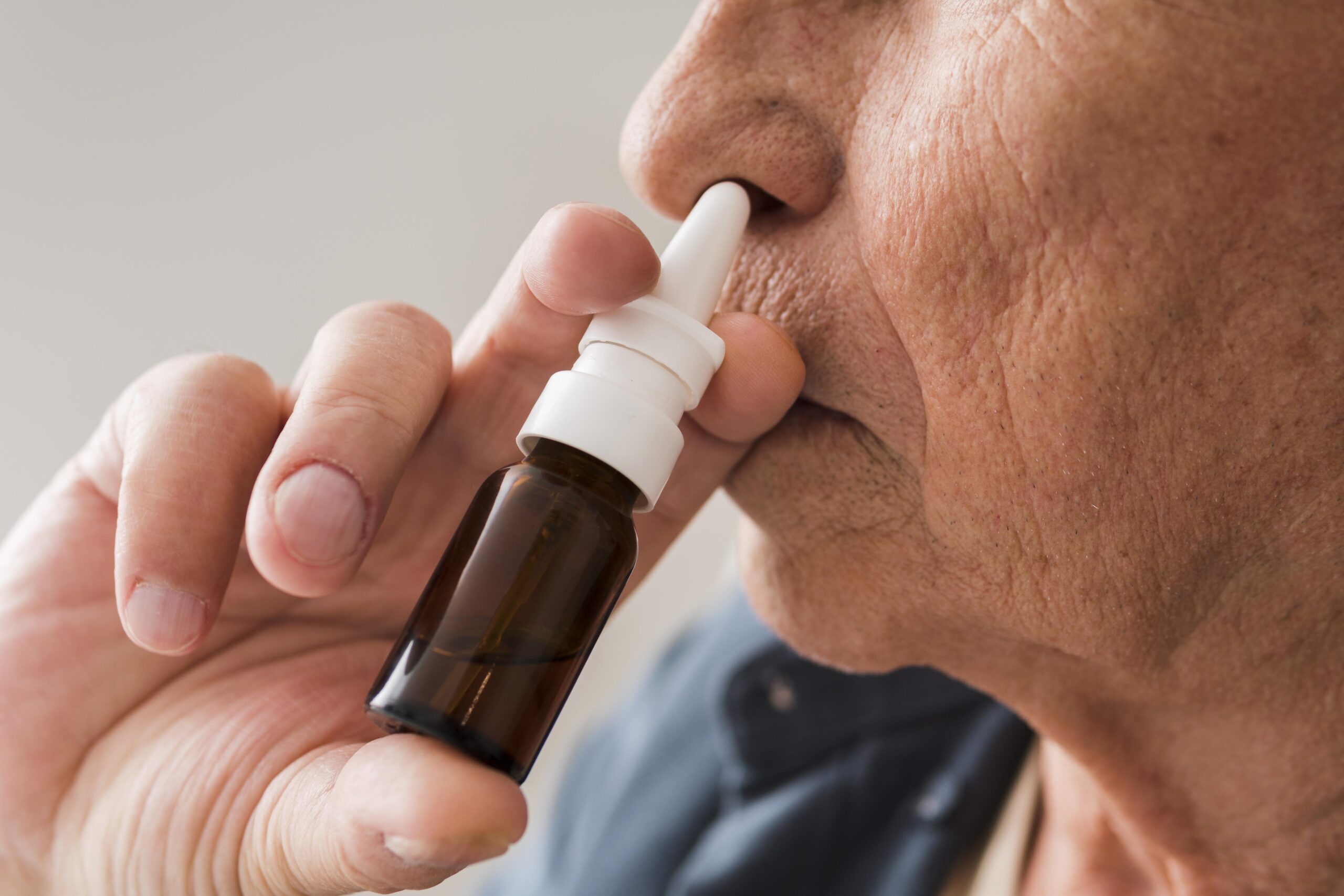
When the spray is administered through the nose, these vesicles travel directly along the olfactory nerve pathway into the brain — bypassing the blood-brain barrier, the protective shield that normally blocks large molecules from entering brain tissue and has frustrated drug developers for decades.
Once inside the hippocampus, the EVs deliver their microRNA cargo directly to microglia — the very cells driving neuroinflammaging — and instruct them to stand down. Specifically, the treatment targets and suppresses two key molecular pathways responsible for sustaining chronic brain inflammation: NLRP3 and cGAS-STING. Both are known drivers of the inflammatory signaling that accumulates in the aging brain.
But the spray does not stop at fighting inflammation. It also delivers signals that restore the function of mitochondria — the energy-producing structures inside brain cells. In aged brains, mitochondria become less efficient, contributing to the mental fog and cognitive sluggishness associated with aging. The EV therapy appears to recharge these cellular power plants, restoring the energy supply that neurons need to form and retrieve memories.
What the Research Found
The study tested the spray on mice at 18 months of age — broadly equivalent to a 60-year-old human in terms of brain aging. Compared with untreated animals of the same age, mice that received just two doses of the EV nasal spray showed striking improvements across multiple measures.
Brain tissue analysis revealed significantly reduced markers of microglial activation and chronic inflammation. The mitochondria in hippocampal neurons were functioning better. And in behavioral tests designed to measure memory and cognitive flexibility, the treated mice outperformed their untreated counterparts in several ways: they were better at recognizing familiar objects they had encountered before, more alert to changes in their environment, and able to adapt more quickly to new situations.
These are not trivial measures. The ability to recognize familiar objects and detect when something in a known environment has changed maps directly onto the kinds of memory that decline first in humans with early-stage Alzheimer’s disease.
The results appeared within weeks of treatment and held for months — an unusually durable effect for a therapy delivered in just two doses.
Dr. Shetty described what he believes is happening at the cellular level: “We are seeing the brain’s own repair systems switch on, healing inflammation and restoring itself. As we develop and scale this therapy, a simple, two-dose nasal spray could one day replace invasive, risky procedures or maybe even months of medication.”
Why the Delivery Method Matters
Much of the excitement around this research is not just about what the treatment does — it is about how it gets there.
The blood-brain barrier has long been one of the most formidable obstacles in neuroscience. It exists to protect the brain from pathogens and toxins, but it also blocks the vast majority of potential drug candidates, making it extraordinarily difficult to deliver treatments directly to brain tissue. Most existing neurological drugs must be reformulated, packaged in special carriers, or administered via invasive procedures to have any hope of reaching their targets.
A nasal spray that delivers therapeutic cargo directly along the olfactory nerve — into the hippocampus, the seat of memory — sidesteps this barrier entirely. If the approach translates to human therapy, it would make what is currently an enormously complex medical challenge as straightforward as treating a blocked nose.
The Scale of the Problem It Could Address
The urgency behind this research becomes clear in the numbers. Approximately 42% of Americans over the age of 55 are currently estimated to develop some form of dementia during their lifetime. The annual number of new dementia cases in the United States — around 514,000 in 2020 — is projected to nearly double to approximately 1 million per year by 2060, driven by an aging population.
Globally, Alzheimer’s disease and other dementias affect over 55 million people, a figure expected to rise to 139 million by 2050 according to the World Health Organization. Current treatments do not reverse cognitive decline — they slow it, and only in some patients, and only for a time. A therapy that could actually turn the clock back on the brain’s inflammatory state would represent a fundamental shift in how medicine approaches aging.
“Brain age-related diseases like dementia are a major health concern worldwide,” Dr. Shetty said. “What we’re showing is that brain aging can be reversed, to help people stay mentally sharp, socially engaged, and free from age-related decline.”
What Comes Next
The team is clear about where the research currently stands. This was a preclinical study — the subjects were mice, not humans — and the path from promising animal results to a clinically approved human therapy is long, demanding, and not guaranteed.
More research is needed to confirm the treatment’s safety profile, establish optimal dosing, and determine how effectively the therapy translates to the far more complex human brain. The researchers must also demonstrate that the EVs can be produced consistently at scale and that the effects observed in aged mice are reproducible across different biological contexts.
But the momentum is real. Texas A&M has already filed a U.S. patent for the nasal spray therapy — a signal that the university is taking the technology seriously as a candidate for commercial development. The research team is actively working toward a version of the treatment that could eventually enter human clinical trials.
The goal, as Dr. Shetty put it, is a future where the neurological clock does not just slow down — it turns back.
Key Facts at a Glance
| Detail | Data |
|---|---|
| Institution | Texas A&M University Naresh K. Vashisht College of Medicine |
| Lead Researcher | Dr. Ashok K. Shetty, Institute for Regenerative Medicine |
| Funded By | National Institute on Aging (NIA) |
| Treatment Type | Extracellular vesicles (EVs) from human neural stem cells |
| Delivery Method | Intranasal spray (bypasses blood-brain barrier) |
| Doses Required | 2 doses |
| Effects Observed | Reduced neuroinflammation, restored mitochondrial function, improved memory |
| Duration of Effects | Improved function persisted for months |
| Target Pathways | NLRP3 and cGAS-STING inflammatory signaling |
| Study Subjects | 18-month-old mice (~60-year-old human equivalent) |
| Patent Status | U.S. patent filed by Texas A&M |
| Journal | Journal of Extracellular Vesicles, 2026; 15 (2) |
Original Journal Source
Peer-Reviewed Paper: Leelavathi N. Madhu, Maheedhar Kodali, Shama Rao, Sahithi Attaluri, Raghavendra Upadhya, Goutham Shankar, Bing Shuai, Yogish Somayaji, Shruthi V. Ganesh, Vignesh S. Kumar, Jeswin E. James, Padmashri A. Shetty, Avery LeMaire, Xiaolan Rao, James J. Cai, Ashok K. Shetty. “Intranasal Human NSC-Derived EVs Therapy Can Restrain Inflammatory Microglial Transcriptome, and NLRP3 and cGAS-STING Signalling, in Aged Hippocampus.” Journal of Extracellular Vesicles, 2026; 15 (2). 🔗 DOI: 10.1002/jev2.70232
University Press Release — Texas A&M Stories: 🔗 Scientists reverse brain aging, with a nasal spray
Scienceable.net covers the latest peer-reviewed research in health, medicine, and neuroscience. For more stories like this, visit our Neurology & Aging section.